This is the companion piece to the technical article. If you want the architecture deep-dive and training recipe, go there. This one is about why — the motivations, the data, the surprises, and the conviction that got me to spend a night reverse-engineering a training loop from inference code.
The three problems that pushed me to train
1. Anime quality is HiDream-O1's weak spot
HiDream-O1-Image is objectively a top-tier model — #8 on the Artificial Analysis Arena, open-weight, 8B params punching way above its weight. For photorealism and text rendering, it's stunning.
For anime and illustrated styles, though — it's soft. The rendering leans painterly and a bit generic. You can nudge it with prompting, but at some point it's a model-capability ceiling, not a prompt problem. The base model simply wasn't trained on enough high-quality anime-style data, or the training distribution emphasized photorealism.
I knew this because I've been serving the model on my platform and watching the outputs. And the more I used it, the clearer it became: the only real fix is a LoRA.
2. The I2V pipeline made image quality the bottleneck
I've been deep in the LTX-2 video generation trenches — cold-start architectures, fp8 quant, community variants, the whole thing. Video quality from LTX-2 has been improving fast, especially with community models.
But here's the thing about image-to-video: garbage in, garbage out. If your input image is a soft, generic HiDream render, the resulting video inherits that softness. The I2V pipeline gets better, and suddenly the bottleneck isn't the video model — it's the image model feeding it.
Training an aesthetic LoRA for HiDream closes that gap. Better stills → better video.
3. The censorship concern (which turned out to be half-wrong)
I went in assuming HiDream-O1 would be heavily censored — the way some models refuse to generate even mild nudity. One stated motivation was "freedom of creative expression."
Turns out, the base model is surprisingly permissive with nudity. Give it a NSFW prompt and it'll generate bare skin without complaint. The "censorship" fear was partly misplaced — at least for artistic nudity.
This shifted my understanding of what the LoRA actually does. It's not an "uncensor" — the base model doesn't need that. What it adds is visual quality on top of NSFW content: the same directional lighting, glossy rendering, and stylization improvements that it brings to SFW images. And critically, it makes NSFW prompt-controllable — on only when you ask for it.
The data: 191 hand-picked images and a local VLM
I didn't scrape a million images. I manually curated 191 high-quality illustrations from my personal taste: anime, pop-art, and semi-realistic styles, mostly from CivitAI RED rankings. Portrait-heavy, diverse aspect ratios, no captions.
The captioning pipeline was straightforward: a locally-running Gemma-4 E4B (multimodal VLM, free, no API costs) described each image in natural-language prose — the style HiDream's text encoder expects. Each caption got prefixed with kotonia style as a trigger phrase, and NSFW images got explicit descriptors woven in (NSFW, topless, ...).
Total cost: $0. 191 images, ~10 minutes of captioning on a local GPU. The entire dataset lives in a single directory with .txt sidecars and a styles.json metadata map.
Style breakdown: 100 anime / 69 semi-real / 21 other / 1 pop. NSFW: 34 out of 191.
The surprise: blended styles didn't mush
I was worried about this. Anime + semi-real + pop mixed in one LoRA — would it average everything into a bland middle? That's a common failure mode.
It didn't. The LoRA produces a coherent modern-anime / CivitAI aesthetic — directional lighting, glossy rendering, more confident stylization — without looking like it's stuck between styles. It learned the quality signal across styles rather than averaging their surfaces.
This might be because the "high quality" signal is actually shared across these styles — good lighting, clean lines, appealing proportions — and the LoRA latched onto that common factor. Or it might be because 191 images is small enough that the model can't over-specialize. Either way, no clustering was needed.
NSFW: the conversion driver signal
Here's something I didn't expect to learn. On my platform, the noindex NSFW article was #1 in unique page views — ahead of all the clean, SEO-optimized technical articles.
The internet is telling me something. People want this content, and they're willing to spend time with it. The question is whether some percentage of those viewers convert to platform signups and make the noindex tradeoff worth it. The math: if even a small fraction of NSFW readers register and become paying users, it more than covers the SEO traffic you "lost" by putting it behind noindex.
This isn't a new insight — it's the same dynamic that made Patreon and OnlyFans work — but seeing it in my own analytics made it real. The LoRA's NSFW capability isn't a side effect; it's a deliberate part of the product strategy.
NSFW samples
Content warning: artistic nudity / swimsuit-level imagery.
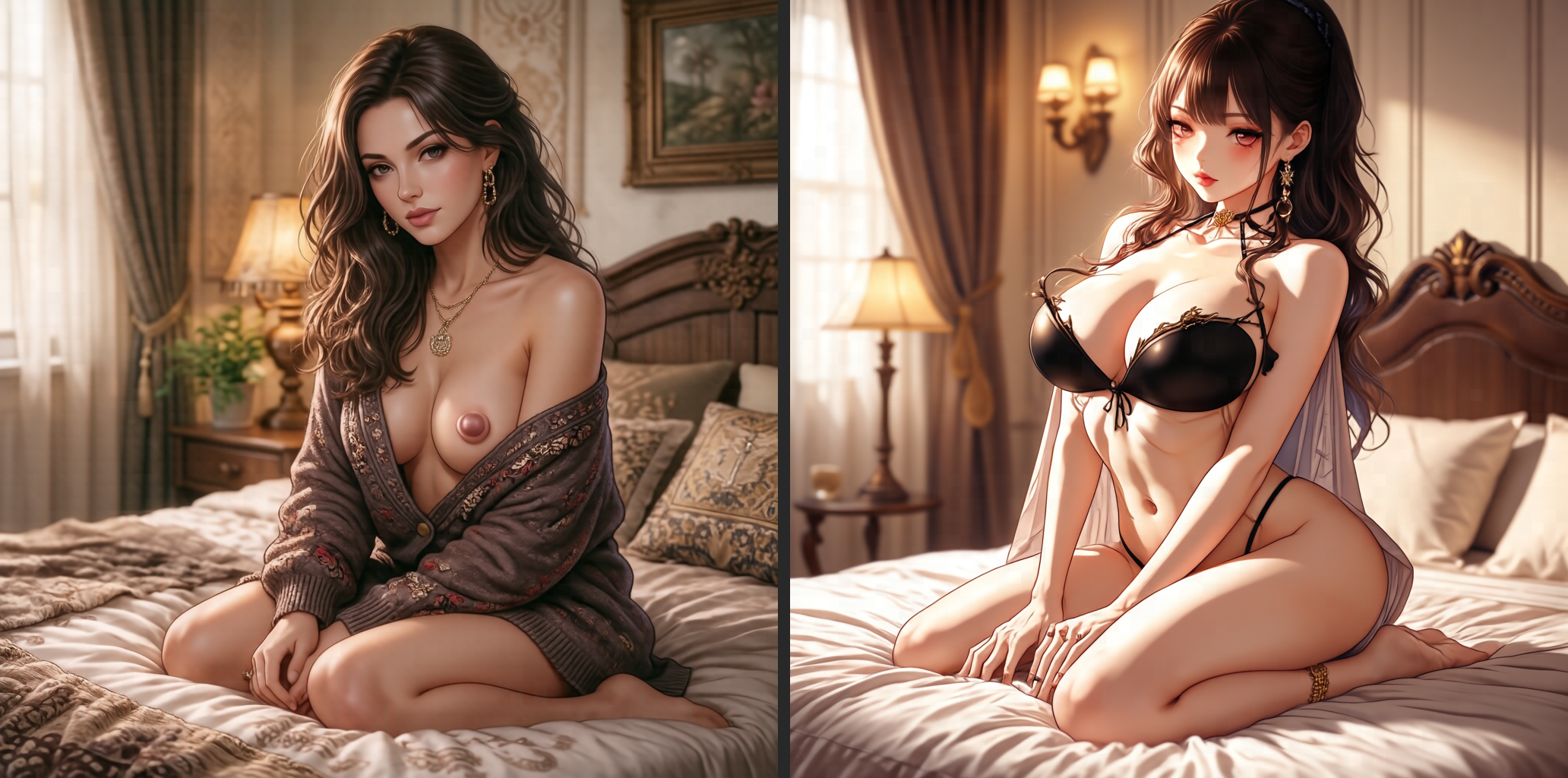
The LoRA's NSFW behavior: it applies the same visual improvements (lighting, skin rendering, stylization) to NSFW content that it does to SFW. The gating works — SFW prompts with the same trigger produce fully clothed output. The base model does the nudity; the LoRA makes it look better.
What this means going forward
This LoRA is a proof of concept, but it's also the foundation. The same pipeline — inference-code reverse-engineering → PEFT LoRA attach → flow-matching x0-MSE → local VLM captioning — can train any kind of O1 LoRA:
- Character LoRAs for consistent OCs across scenes
- NSFW-specialized LoRAs with higher NSFW ratio in the dataset
- Art-style LoRAs targeting specific illustrators or movements
- Multi-LoRA stacking — aesthetic booster + character + NSFW, all independently triggerable
The code is open, the training costs $0 in API fees, and the model is open-weight. The only barrier is knowing the recipe — and now you do.
Full training code: https://github.com/zhener562/hidream-o1-lora. The LoRA is available on kotonia.ai/studio.